Analysis Sports23 Desk 4 min read
Schmelke CC Series Compared: Five Custom Cues From $315 to $475
The Wisconsin maker's CC lineup spans eight-point rosewood designs, all-black carbon builds and a premium Bocote four-prong model.
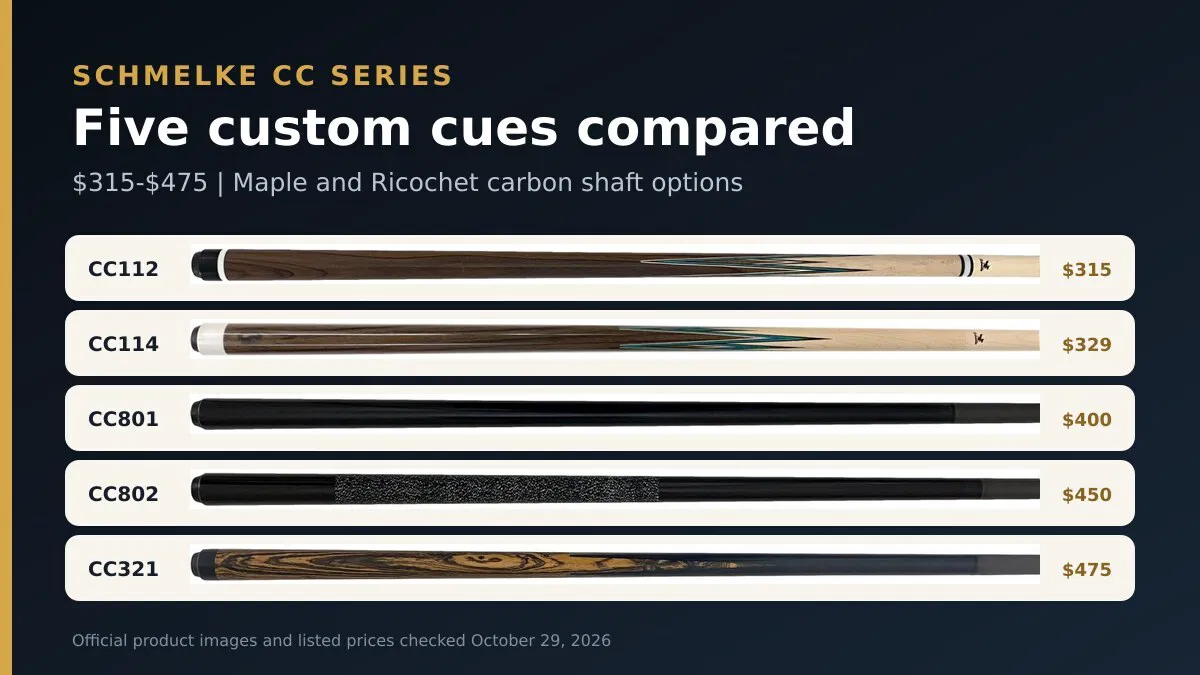
Schmelke's current CC Series covers five in-stock catalog designs priced from $315 to $475. Two use North American hard maple shafts and traditional veneered wood construction, while three pair Ricochet carbon shafts with either an all-black butt or a Bocote four-prong design.
The lineup is best understood as configurable custom cues rather than five blank-sheet commissions. Each product page starts with a defined model and lets buyers select options such as weight, shaft diameter, joint, tip and other details. Prices and stock status below were checked on October 29, 2026; a selected option can change the final total.
How do the five Schmelke CC Series cues compare?
| Model | Listed price | Shaft | Butt and forearm design | Wrap | Current status |
|---|---|---|---|---|---|
| CC112 | $315 | North American hard maple | Eight rosewood points with green veneers | None | In stock |
| CC114 | $329 | North American hard maple | Maple forearm, rosewood grip area and eight veneered points | None | In stock |
| CC801 | $400 | 12.5 mm Ricochet carbon | All-black ebonized maple | None | In stock; only three shown |
| CC802 | $450 | 12.5 mm Ricochet carbon | All-black ebonized maple | Black-and-white linen | In stock |
| CC321 | $475 | Ricochet carbon, listed as 12.5 mm in the specification table | Bocote four-prong design | None | In stock |
The $160 gap between the CC112 and CC321 does not create a simple quality ladder. It mainly separates two wood-shaft builds from three carbon-shaft configurations and reflects different butt construction, wrap treatment and materials.
Which models keep the traditional maple-shaft format?
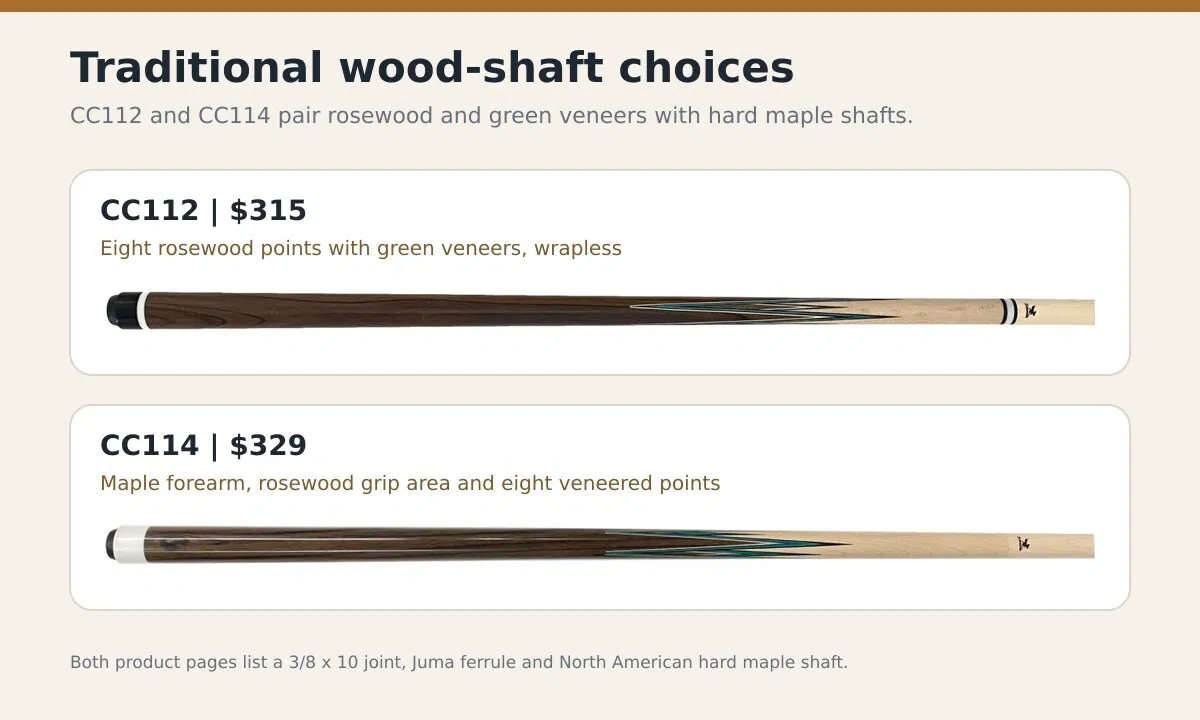
The CC112 is the least expensive model in the group at $315. Schmelke describes a wrapless East Indian rosewood butt with eight rosewood points and green veneers. The current page lists a hard maple shaft, high-impact Juma ferrule, premium leather tip, 10- to 12-inch pro taper and 3/8 x 10 joint.
The CC114 costs $329 and shifts the visual balance. Its page describes a maple forearm, rosewood grip area and alternating rosewood points with maple and green veneers. The listed shaft, Juma ferrule, pro taper and 3/8 x 10 joint closely match the CC112.
That makes the $14 decision more about layout and color distribution than a major mechanical change. Both pages show no wrap, so neither model is the obvious answer for a player who specifically wants the texture of linen.
How do CC801 and CC802 differ?
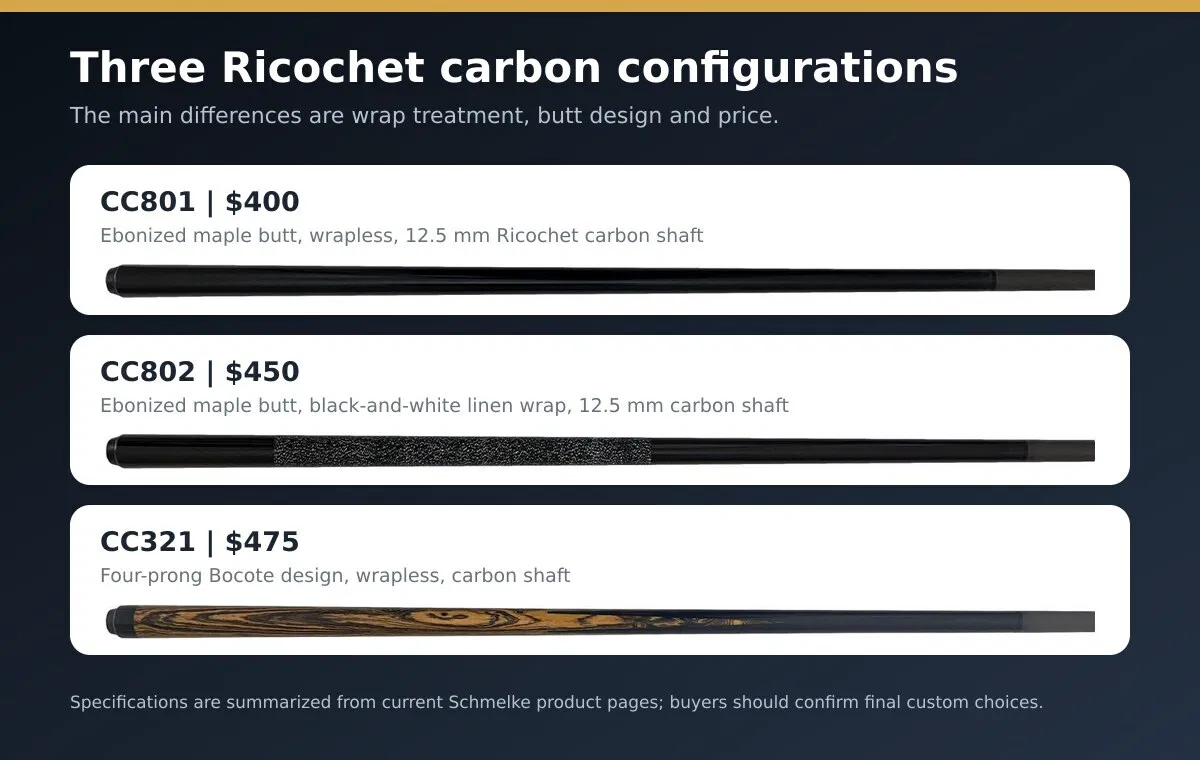
The CC801 is the lowest-priced carbon option at $400. Its current specification block lists a 12.5 mm Ricochet carbon shaft, 15-inch pro taper, 3/8 x 10 joint, medium premium leather tip, ebonized maple forearm and no wrap. Schmelke also shows only three remaining, which is an inventory snapshot rather than evidence of sales velocity.
The CC802 adds $50. Its core specifications closely mirror the CC801, including the 12.5 mm Ricochet carbon shaft, ebonized maple construction and 15-inch pro taper. The clearest published difference is the black-and-white linen wrap. Players deciding between the two should therefore focus on grip feel and appearance, not assume the higher price automatically means better performance.
Both pages contain small copy errors, including an incorrect model reference in the description. The product titles, SKUs and structured specification blocks consistently distinguish CC801 as wrapless and CC802 as the linen-wrapped version.
What makes CC321 the most expensive model?
At $475, the CC321 combines the carbon-shaft category with a more traditional wood presentation. Schmelke describes a Bocote butt and long prongs, a wrapless build, adjustable weight and a 3/8 x 10 joint. The structured specifications list a 30-inch, 12.5 mm Ricochet carbon shaft and premium leather tip.
The page is not fully consistent: one sentence says 12.4 mm while the tables say 12.5 mm, and the forearm is described as both maple and ebony in different places. That conflict matters when ordering. Buyers should ask Schmelke to confirm the exact shaft diameter and forearm construction on the final configuration rather than treating every line of the page as interchangeable.
Are CC Series cues fully bespoke?
Not in the same sense as a one-off cue designed from a blank sheet. Schmelke presents these as named catalog models with a base design and selectable custom options. That can make the buying process more predictable: a buyer begins with a visible model, published starting price and a menu of available choices.
Schmelke says its family has made custom pool and billiard cues in Northwest Wisconsin for more than 50 years. The current collection page lists all five models as in stock, but custom selections can affect cost and fulfillment. Before ordering, confirm the current price, included shaft, exact tip and diameter, wrap choice, joint, weight and estimated completion date.
Which Schmelke CC Series cue fits each buyer?
The CC112 is the lowest-cost route to the eight-point rosewood-and-green look. The CC114 suits a buyer who prefers more visible maple and a rosewood grip section. The CC801 is the value pick for a wrapless black cue with a Ricochet carbon shaft, while the CC802 targets players who want similar published specs with linen under the hand. The CC321 is the premium option for someone who wants carbon-shaft construction without giving up the visual character of Bocote prongs.
Those are configuration differences, not proof that one model will play better for every person. The useful comparison is between shaft material, wrap feel, butt design and confirmed final specifications - followed by the buyer's own preferences for balance, taper, tip and diameter.